by Joe Persinger
@Brew_Mastr_Joe on twitter
Ever since I began watching baseball, I've always wondered what it would have been like to watch a game at Ebbets Field. Or what the rooftop views from Schibe Park looked like, the smell of the grass, freshly popped popcorn at Crosley Field, and the ivy covered spacious outfield walls of Forbes Field.
Over the last 20 years, many retro-modern baseball parks have began to spring up. Giving fans a feel for the golden years, but with all the amenities these modern times have to offer.
But are they really "retro-modern"?
I think "modern-retro" would be a more appropriate.
Most design companies have done a great job incorporating the old with new, but something isn't right. The newer baseball parks capture that moment in time, but only at field level. By the time I walk to the concourse there are flat screen TV's, digital connections everywhere, food coming at me in every direction, along with some of the cheesiest promotions I have seen.
As a little kid I used to think to myself: "If I ever fall into a large sum of money, I am going to give it back to baseball by rebuilding all the old baseball parks!"
But then the child I was grew up (sort of).
I started to see how evil, cynical, and greedy this world can actually be and once I was old enough to figure out financing, property taxes, leases, overhead, and the rest of the headaches involved, I moved on.
But I can still dream.
In the concrete and steel era of ballpark construction and design, the new ballparks of yesterday were born. Most of these stadiums, parks, and ball fields became synonymous with the golden era that they thrived in.
With Fenway Park celebrating 100 years, and Wrigley Field being right behind it, I've created a list of the most memorable ballparks that have existed in the Major League's.
As a daily addition to Joe's Sports Corner, I will release one ballpark each day that has disappeared over the years. I've listed each edifice when it was constructed with a brief description about the features and history.
Then I'll ask and answer 2 questions.
What's There Now? & Is It Possible To Rebuild?
Bringing back that golden era of jewel box, retro ballparks would only add to mystique of baseball. Anyone that has ever been to a game at Fenway Park or Wrigley Field, knows how timeless baseball can be. It's a gift that should be shared throughout the league.
Even if it would be on a part time basis.
Here is today's edition of "Rebuilding MLB's Past":
As Ty Cobb continued to play at a high level for the Tiger's, his base stealing and hitting ability helped fill the stands and ultimately helped the Tiger's finance their new ballpark.
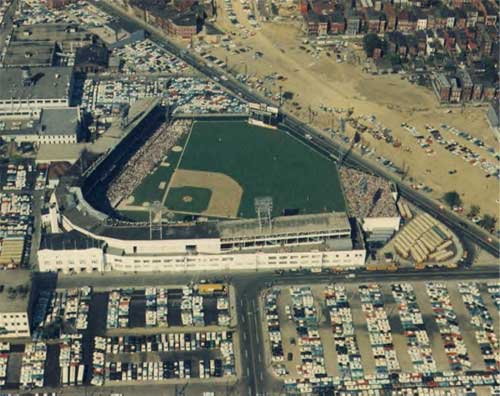
Navin Field was named after then, Tiger's owner, Frank Navin. The name was changed to Briggs Stadium in 1938, and changed again to Tiger's Stadium in 1961 by the new owner, John Fetzer.
Opened on April 20, 1912(9 days after Crosley Field), Tiger Stadium, as most of us remember it, wasn't the original design.
Double decker grandstands curved around home plate to the first and third base sides. Beyond the double decker grandstands, were single decked pavilions that extended to the outfield walls. Bleachers ran across the perimeter of the outfield walls , bringing the total capacity of newly built stadium to 23,000 seats.
The ballpark was renovated to include double decker grandstands from foul pole to foul pole and across right field in 1935. The overhang of the right field grandstand, known for obstructing views, was the "home run" porch was only 320 feet from home plate.
3 years later, city hall relocated and the double decker grandstands were extended through left field bringing the stadium capacity of 52,416.
The double decker grandstands were some of the best views in Tiger Stadium giving every spectator the feeling of being right on top of the action.
The ballpark was the site of Babe Ruth's 700th home run which cleared the right field (single deck) bleachers. On May 2, 1939 Lou Gehrig pulled himself from a Yankees/Tigers game, in Detroit, ending his iron man record at 2,130 games.
 Tiger Stadium also hosted three All Star games in 1941, 1951, and 1971.
The ball club wanted a new stadium, despite the resistance from traditionalist fans, who wanted to keep the team in Tiger Stadium. Despite this, the team left the ball park after the 1999 season and moved to Comerica Park in downtown Detroit.
Many preservationists groups fought to keep the historical edifice erect, but after a few chances given to them by the city, their efforts were in vain.
The final stages of demolition was finished on Sepetember 21, 2009.
The baseball diamond and the center field flag pole still exists today. I'm not sure if it's open to the public, but the field has been preserved and with 18 of your friends, is ready for a pick up baseball game.
Is It Possible To Rebuild?
Yes. The site remains vacant since the final stages of demolition. The baseball diamond has been restored by Detroit citizens in the surrounding communities and the only thing stopping the reconstruction would be money and building permits. A Michigan senator has also stated there is $3.8 million federal dollars earmarked for the park's preservation.
5-8-12
Crosley Field
Home of the Cinncinatti Red's, Crosley Field was one of the most memorable ballparks of it's time. Originally named Redland's Field, the concrete and steal bandbox was one of the smallest ballparks(only 25,000 seats)constructed in that era.
A double decker grandstand was built around the diamond with a single decked pavilion further down the third and first base line. There was no seating in left or center field, just a trapezoid like shaped bleacher section out in right field dubbed, "The Sun Deck" or "Moon Deck" for night games.
Lights were erected in 1935 for night games and upper decks were added to the left and right field pavilion's. These were the only two changes the ballpark received in it's 58 year existence.
 |
| The terrace is visible in the deepest part of Left Field |
A stapled feature in the Midwest "bandbox" was the 15 degree incline in left field known as "The Terrace". The notorious left field feature served many purposes over it's existence. "The Terrace" served as a standing room area in a time where fans would sit in a roped off section on the field. Although "The Terrace" was mostly prominent in left field, it did extend all the way through the outfield and served also as a warning track for outfielders.
I'm sure a lot of knees were injured over the years from this incline.
Crosley field's decline began in the 1950's when the car became the primary mode of transportation. The lack of parking plagued the ball field in it's last 15 years, as did crime, making the area increasingly unsafe, especially during night games.
What's There Now?
A large building and parking lot occupies the grandstands, and the main field of play. The Cincinnati Whole Sale Florists sit in left field extending to the foul line and grandstands, and a printing company sits atop "The Terrace".
If you ever visit the site and look at the parking lot between the Whole Sale Florists building and the printing company building, "The Terrace" incline is still visible.
Is It Possible To Rebuild?
No.
Seven buildings occupy the land the ballpark used to sit on. Dalton street (which used to dead end at Finlay), now runs through what was then the field of play, now connects to York Lane which is what the left field wall used to run parallel.
A version of Crosley Field was erected in the suburb of Blue Ash, Ohio as part of the community sports complex. The little league ball park holds true to the dimensions of the original and has a recreated version of the scoreboard in left field. A 400 seat grandstand sits on the third base side, but outside of those features, its just an over the top little league field.
If I was a billionaire, I would rebuild Crosley (knowing I'd be loosing money) on a smaller basis, but on the same site.
I would build the newly created field on the corner of Findlay & Dalton Streets. The layout would still hold true to the original perimeter of the outfield, it would just have smaller dimensions, but still hold true to the features of it's predecessor. The scoreboard in left field, "The Terrace" in left field that also spans the entire outfield, and the "Sun and Moon" deck.
I would still hold true to the grandstand layout, but I would construct the 1912 version. Double decker grandstands along the diamond with the pavilions beyond first and third base sides.
Although a MLB game would never be played here, it would be a great site for an All Star game exhibition game of some sort(if Cincinnati were to receive the honors).
Another timeless ballpark ripped from our hands because some fat cat wanted to make a few extra bucks.
5-7-2012
Comiskey Park
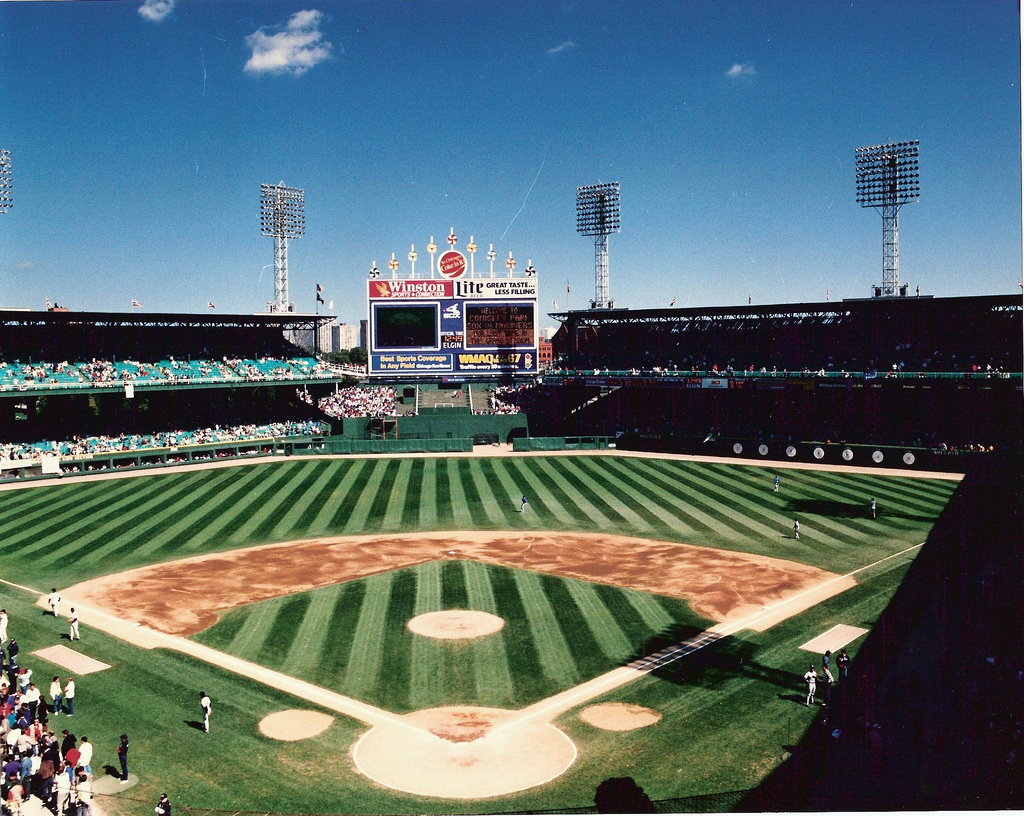
Built on the site of a former city dump (yes that pun was intended), purchased by Comiskey in 1909, this pitcher friendly ballpark was erected July 1, 1910. The third reinforced concrete and steal ballpark, it was nicknamed, at the time, the "Baseball Palace of the World". It sat an astounding 28,900 fans and was built to suit the style of play the White Sox. Great defense and with a side of small ball.
The south side ballpark hosted 3 consecutive World Series in 1917, 1918, 1919. And another World Series against the LA Dodger's in 1958.
The Red Sox and Cubs faced off in the 1918 World Series. Instead of playing at Wrigley Field, the Cub's owners, felt it would be more prudent and profitable to move the game to Comiskey Park. With 29,000 seats (compared to 14,000 at Wrigley), Comisky offered more of a fiscal promise than the North Side ballpark.
Comiskey Park was the site of the first ever All-Star Game in 1933, and hosted that same game 50 years later. It also hosted the 1983 ALCS, which the White Sox lost.
 White Sox chairman Jerry Reinsdorf threatened to move the team to Florida if his team didn't receive some sort of subsidy from public funding.
He received $200 million and built a "ball mall" across the street from the "Baseball Palace of the World".
What's There Now?
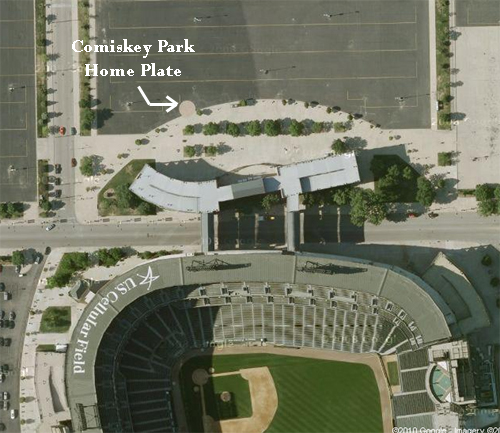
After it's demolition the lot was turned into a parking lot to accommodate fans attending, what is now called, US Cellular Field. The White Sox memorialized the park by painting the old foul lines in the parking lot and placing a marble home plate plaque where the original once stood. The 35th Street spectator ramp pays an om age to "Old Comiskey" by mirroring the old grandstand.
Is It Possible To Rebuild?
Yes. The land was turned into a parking lot and the only structure occupying the lot is the spectator ramp which connects to the "Ball Mall" across the street.
The rebuilding of the "Old Comiskey" would be a mirror image of its predecessor's, but would be built with modern technology and with a few modern alterations.
The important aspects of rebuilding would be the exterior of the ballpark, all of the famous arched windows, and the right field patio, and the iconic scoreboard. Keeping true to the large dimensions the ballpark had in it's early days would be ideal and gives newer generations a glimpse into where the game was played almost 100 years ago.
But what would happen to the parking lot?
With plenty of parking already available and the CTA Red Line across the street, I'm sure die-hard White Sox fan's wouldn't mind making the sacrifice to have their old home back.
If Cub's fan can do it, why can't the south side hobo's do it?
Just kidding.
5-4-2012
Forbes Field
Barney Dreyfuss, owner of the Pittsburgh Pirates, wasn't going to let Ben Schibe and Connie Mack one up him with their newly constructed state-of-the-art ballpark. Dreyfuss built the new ballpark in an undeveloped part of Pittsburgh leading to criticism from fans and media alike. When the ballpark was finished and the land began to develop, the criticism relented.
Refusing to allow "cheap home runs" in his new ballpark, Dreyfuss created long dimensions in left field(360 feet), center field(462 feet), right field(376 feet). All of the outfield walls were covered in ivy and was the first ballpark with this feature, not Wrigley Field.
With large dimensions, triples and inside-the-park home runs were very common. Although the park was known as "pitcher friendly", but never had a no-hitter pitched inside it's walls in its 61 years of existence.
Over the years, the infield began to develop a "rock hard" surface causing the ball to take unexpected bounces. Pirates play-by-play announcer Bob Prince nicknamed the ballpark "The House of Thrills" because of the unexpected path of bounces the baseball would make.
What's There Now?
The University of Pittsburgh purchased the field from the Pirates in 1958 and ended up demolishing the pitchers paradise in 1971 to make room for buildings and roads to service the University. Home plate sits in Posvar Hall in it's original location. This has been disputed by some, saying the "actual" original location of home plate now sits in a women's bathroom stall.
Is It Possible To Rebuild?
Absolutely not. The land is now occupied by the University of Pittsburgh and they are not going anywhere. What was open space 100 years ago has become so cramped, rebuilding a replica or smaller scale park would be a futile exercise.
The U of P has memorialized the park by encasing home plate on the lobby floor of Posvar Hall and marking the left center, center field brick wall--which stands in the original location--with the dimension markings along Roberto Clemente Drive. A historic plaque has also been placed near the brick wall reminding people of the historical site.
5/3/2012
Schibe Park/Connie Mack Stadium
While the Cub's were busy winning a World Series in 1907, the Philadelphia A's were discovering how popular "America's Pastime" had become in Philadelphia.
Built for 23,000 patrons just West of the "Baker Bowl" for $301,000 (1909 dollars) using the newest technology of the time. Steel reinforced concrete.
Most ballparks of that era were built mainly with wood and were prone to fire damage, and known to decay at a rapid rate.
Fans and owners took notice of the new baseball palace as it sparked a boom of 7 new ballparks being built with the new spacious look and steel reinforced concrete shell.
It was the Camden Yards of it's day.
The first ballpark to construct a double decker grandstand foul pole to foul pole.
All the other team owner's took an envious look at this marvel, and followed suit with their current ballpark, or incorporated them into the plans for their new cathedral.
The signature exterior design is the octangular tower which sat on the southwest corner of the ballpark (behind home plate). The tower served as offices for the Ben Schibe and Connie Mack. The ground floor was a main entrance lobby. According to pitcher Bobby Shantz "..it looked like a church".
The ballpark was known for its huge dimensions when it first opened (center field was 515 feet from home plate), but had been shaved down dramatically by 1968. Home plate was reduced to 415 feet in it's final MLB season.
The A's ended up moving out West in the 1950's, the Phillies ended up leaving the park in 1970, and the Eagles were out of there by the 1959.
Schibe Park remained without a tenant for the rest of it's existence. After a fire in August of 1971 which left the grandstand in ruins, the park remained unkempt until a judge declared it to be demolished.
What's There Now?
In 1991, a church was constructed on the former site and was marked with a historical marker acknowledging when it was constructed, demolished, and how many World Series it hosted over it's lifespan.
Kind of ironic if you ask me.
Is It Possible To Rebuild?
Not really. I dont think a church that was constructed a more than 20 years ago would be willing to sale the land and relocate.
Schibe Park(like most parks of that era)was built in a city neighborhood where land has become sparse and very expensive. There is plenty of land to rebuild in the South Philadelphia Sports Complex, but that would be redundant since the recreated park would be constructed in a parking lot--with other stadiums surrounding it--and not in a neighborhood, which played into the parks atmosphere.